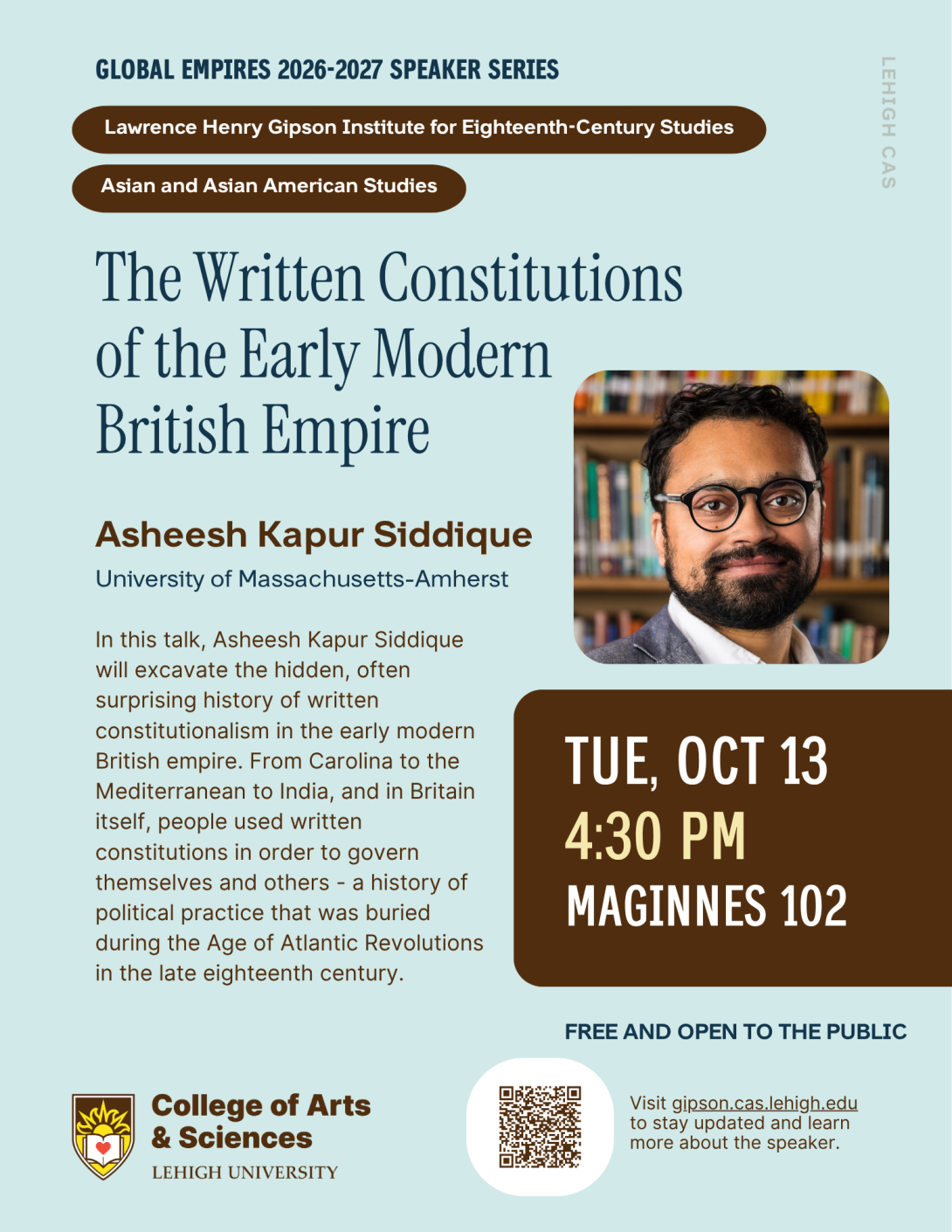
The proliferation of single-document written constitutions among sovereign, internationally-recognized nation-states is one of the most striking features of the contemporary global order. States both old and new - from the United States and France to Afghanistan and the Republic of South Sudan - stake their legitimacy on such texts, which are widely regarded as synonymous with the concept of a nation's fundamental law. By contrast, the few polities seen as lacking these documents - most prominently, the United Kingdom - are viewed as odd exceptions to a rule: a state must possess a single document written constitution in order to be seen as legitimate in the eyes of both its citizens and the world. How did this state of affairs come to be? In this talk, Asheesh Kapur Siddique will excavate the hidden, often surprising history of written constitutionalism in the early modern British empire. From Carolina to the Mediterranean to India, and in Britain itself, people used written constitutions in order to govern themselves and others - a history of political practice that was buried during the Age of Atlantic Revolutions in the late eighteenth century.
Lecture
Maginnes Hall 102
-
Image