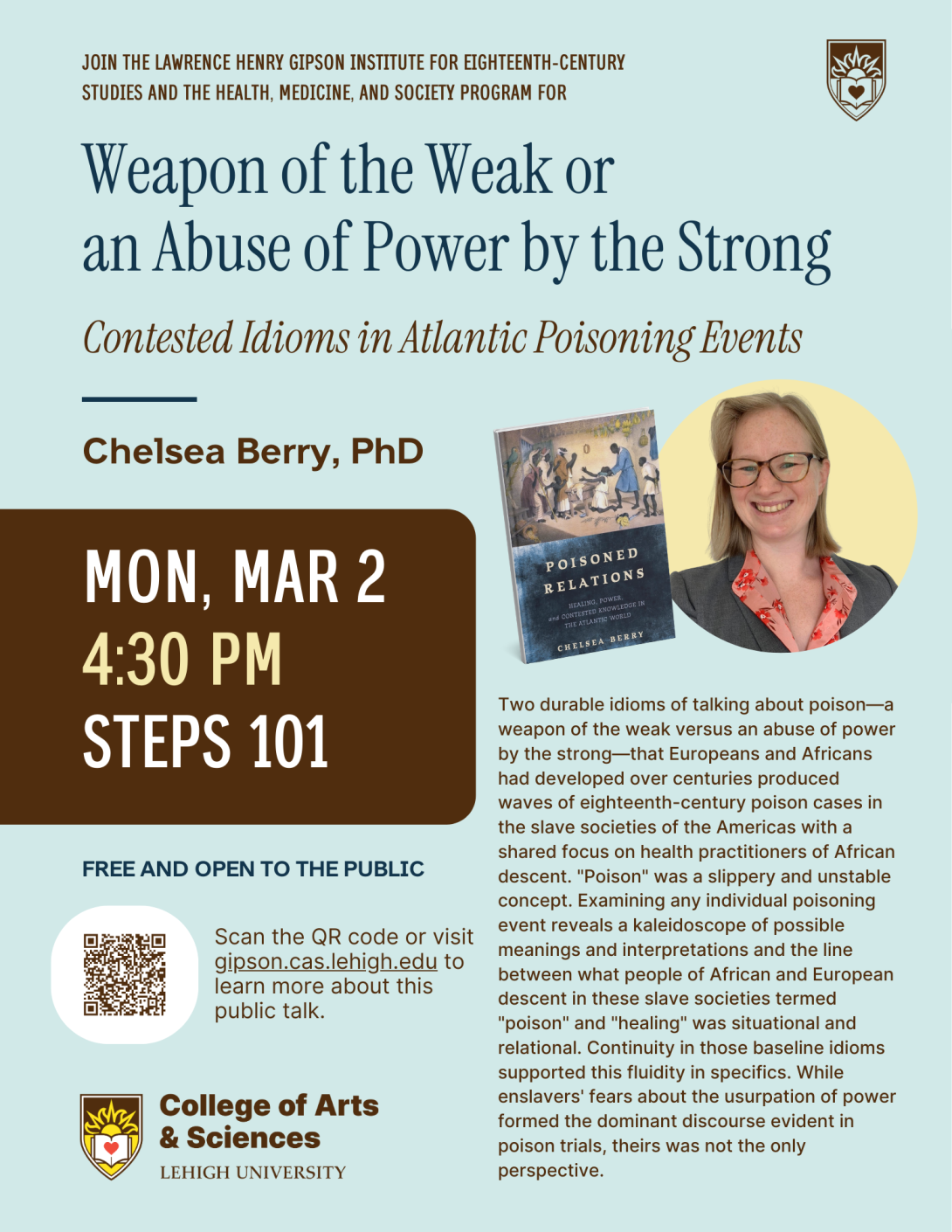
Two durable idioms of talking about poison—a weapon of the weak versus an abuse of power by the strong—that Europeans and Africans had developed over centuries produced waves of eighteenth-century poison cases in the slave societies of the Americas with a shared focus on health practitioners of African descent. "Poison" was a slippery and unstable concept. Examining any individual poisoning event reveals a kaleidoscope of possible meanings and interpretations and the line between what people of African and European descent in these slave societies termed "poison" and "healing" was situational and relational. Continuity in those baseline idioms supported this fluidity in specifics. While enslavers' fears about the usurpation of power formed the dominant discourse evident in poison trials, theirs was not the only perspective. People in enslaved communities had their own concerns, rooted in Atlantic African ideas on political morality, about the actions of extraordinary individuals and how they used or abused their powers.
Chelsea Berry grew up in the woods in the great state of Vermont and has been living in Washington, DC off and on for over a decade. After graduating with an A.B. in History from Brown University, she moved south and earned her Ph.D. in the history of the Atlantic World from Georgetown University. In 2024 she published her first book, Poisoned Relations: Healing, Power, and Contested Knowledge in the Atlantic World, with the University of Pennsylvania Press. She was previously an Assistant Professor of Atlantic History at Randolph College in Lynchburg, VA before entering the world of secondary education. She currently teaches 9th grade and 12th grade at the Holton-Arms School in Bethesda, MD.
This event is co-sponsored by the Health, Medicine, and Society Program and is part of our Illness and Health in the Transatlantic Eighteenth Century 2025-2026 Speaker Series.
Please contact the Office of Research & Graduate Programs at incasgrd@lehigh.edu with any questions.