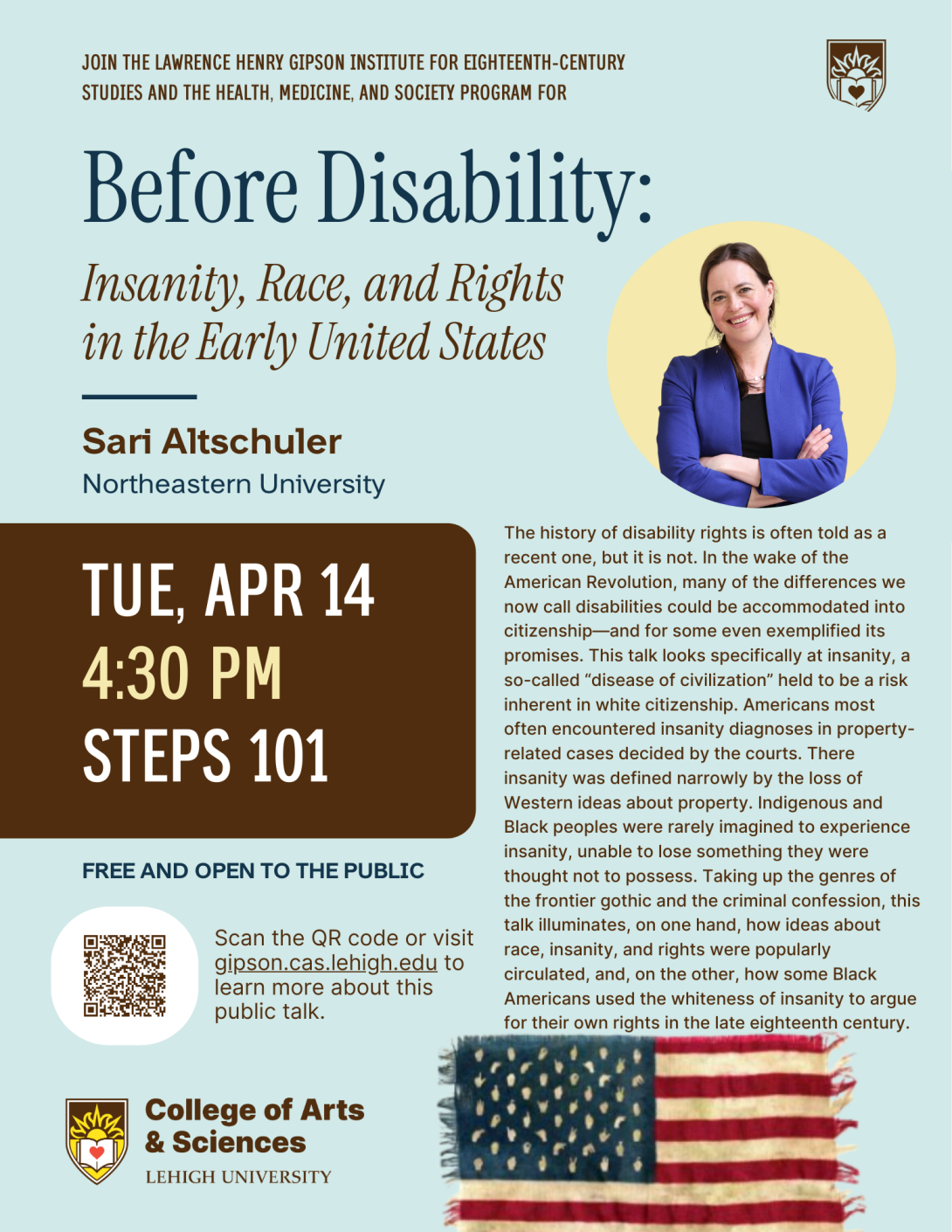
The history of disability rights is often told as a recent one, but it is not. In the wake of the American Revolution, many of the differences we now call disabilities could be accommodated into citizenship—and for some even exemplified its promises. This talk looks specifically at insanity, a so-called “disease of civilization” held to be a risk inherent in white citizenship. Americans most often encountered insanity diagnoses in property-related cases decided by the courts. There insanity was defined narrowly by the loss of Western ideas about property. Indigenous and Black peoples were rarely imagined to experience insanity, unable to lose something they were thought not to possess. Taking up the genres of the frontier gothic and the criminal confession, this talk illuminates, on one hand, how ideas about race, insanity, and rights were popularly circulated, and, on the other, how some Black Americans used the whiteness of insanity to argue for their own rights in the late eighteenth century.
Sari Altschuler is associate professor of English and founding director of the Health, Humanities, and Society Program at Northeastern University. She is the author of The Medical Imagination: Literature and Health in the Early United States (University of Pennsylvania Press, 2018) and Before Disability: A History of American Citizenship (University of Pennsylvania Press, forthcoming June 2026). She is also co-editor of Keywords for Health Humanities (NYU Press, 2023) with Jonathan Metzl and Priscilla Wald.
This event is co-sponsored by the Health, Medicine, and Society Program and is part of our Illness and Health in the Transatlantic Eighteenth Century 2025-2026 Speaker Series.
Please contact the Office of Research & Graduate Programs at incasgrd@lehigh.edu with any questions.